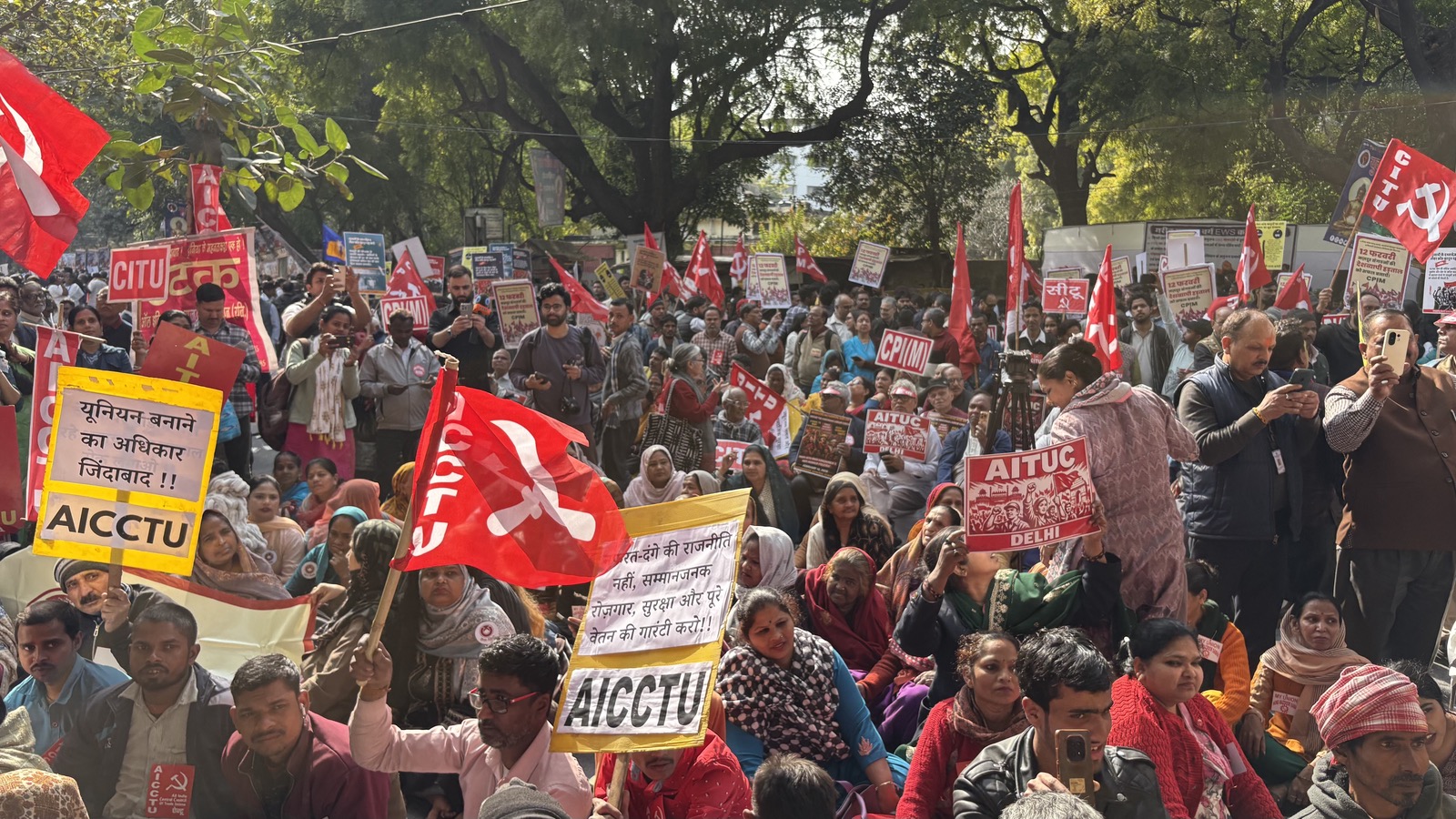
Only our lives are cheap. And everything else, expensive. The rates of gas, room rent, the thali at the dhaba, and even tea have increased, but not our wages.
A worker from Noida, as reported by Frontline , April 25, 2026
Hundreds of thousands of workers are on strike across dozens of companies, with powerful images of yellow‑helmeted construction workers pushing back against police batons while the international media look the other way.
For several months, India’s industrial working class has been mounting a remarkable show of strength. The movement began on January 14, led by construction workers, steelworkers, and petrochemical workers, and it quickly spread to the textile, electronics, chemical, and automotive sectors. Platform delivery workers have since joined, folding themselves into this broad mobilisation driven by India’s industrial workforce.
Though smaller in scale than the massive annual strike day called by the national unions, which some estimates place at more than 300 million participants, the wave of wildcat strikes has shown real disruptive force. In April, in the industrial city of Noida, striking workers held the roads for four days. Thousands of demonstrators were arrested and several union leaders placed under house arrest. After Manesar, Salem, and Vadodara, the strike in Noida became the latest flashpoint in the workers’ struggle.
These strikes deserve close attention from union organisers here. They involve a largely contract-based workforce that now makes up more than 40% of the industrial population, workers who often lack both union protections and the legal protections afforded to permanent staff. This mobilisation also reflects a fierce determination to win rights and better conditions through strike action, at a time when India’s new labour codes are further tilting the playing field in favour of employers.
Cost-of-living, long hours, and a breaking point
This wave of unrest began as a defensive reaction to poor working conditions and a sharp rise in fuel prices. Indian workers, who generally cook with gas, have been hit hard: in some cases, prices have increased eightfold.
That defensive reaction quickly turned offensive, however, with workers pushing for an eight-hour workday and an upward equalisation of minimum wages, which currently vary from state to state.
In the industrial city of Noida, for instance, an unskilled factory worker earned 12,000 rupees a month for a seven-day, twelve-hour-a-day workweek. The same job pays 3,000 rupees more in the neighbouring state. With minimum rent in Noida hovering around 5,000 rupees and deductions cutting take-home pay to roughly 9,000, the math is brutal.1
One of the movement’s most striking features is its ability to bridge religious divisions. Hindu and Muslim workers are fighting side by side against employers and the police of Narendra Modi’s increasingly authoritarian, Hindu ultranationalist government, the same government that wasted no time blaming foreign and Muslim elements for the unrest.2
The industrial working class is already extracting some gains. Several employers have granted minimum wage increases, including 35% in the state of Haryana and 21% in Uttar Pradesh, hoping to defuse the situation, with mixed results. These wages remain well below subsistence level.
Against a global race to the bottom
Beyond this inspiring resistance to the rising cost of living and intolerable working conditions, these struggles offer a lesson in the concrete effects of imperialism on workers’ lives, here and elsewhere. Two forces reshaping the global economy are clearly at work.
The first is the imperialist war in Iran, which is driving the explosion in fuel prices and the inflation of basic goods. For two months, South Asian workers have borne the brunt, and workers in Europe are now feeling it too. North American workers are not exempt. They are next.
The second is India’s rapid manufacturing expansion in recent years. Following the strike waves in China between 2008 and 2015 and again in 2022 and 2023, Western electronics manufacturers turned to India to push wages downward. The US and Indian governments, eager to undercut their Chinese rival, have smoothed the way. The hypocrisy of Trumpist right-wing populism is plain to see: all the talk of local reindustrialisation amounts, in practice, to accelerated offshoring.
India’s working class is refusing the global race to the bottom. When Indian workers keep their capitalists from breathing freely, they cut off a fresh oxygen supply for ours. The hands of workers around the world are well-placed to tighten the grip on our profit-hungry beast.
- T.K. Rajalakshmi, « What Noida’s Worker Strikes Tell Us About the Labour Codes’ Broken Promise, » Frontline, 25 April 2026. ↩︎
- Ibid. ↩︎