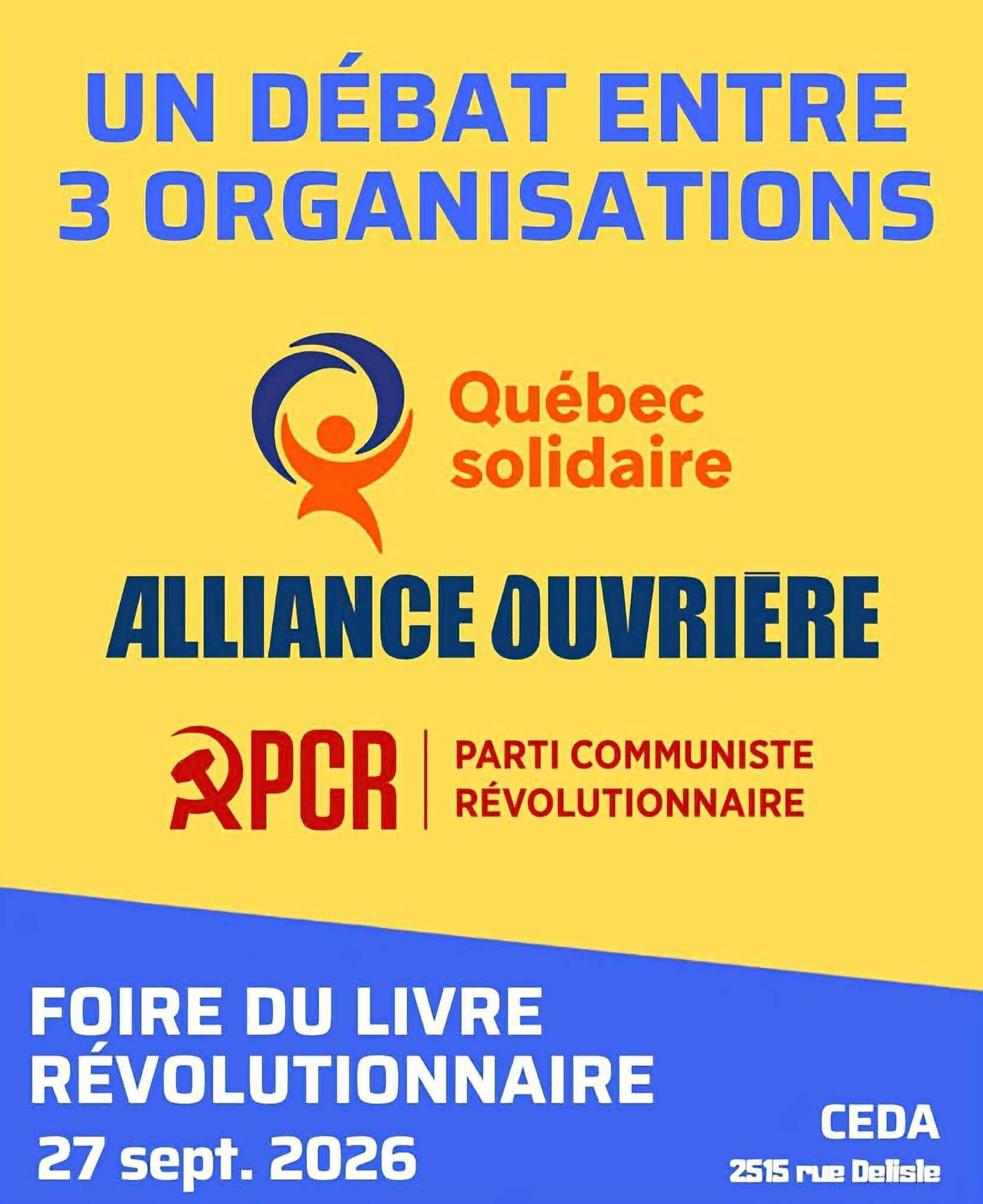
On September 27, Workers’ Alliance (Alliance Ouvrière) participated in an event at the 2026 Foire du livre révolutionnaire (Revolutionnary book fair), co-organized by M Éditeur, Archives Révolutionnaires, and the Revolutionary Communist Party (RCP). The communications secretary of the Montreal chapter debated on the topics of the working class and of the elections with representatives from the RCP and Québec Solidaire (QS). Here is a rough summary of his responses to the fourquestions posed by the moderator.
MODERATOR: In eight days, Quebecers will head to the polls. At this stage, it’s possible to
draw some conclusions about the campaign.
What about the working class? To what extent have its interests, demands, and struggles been
brought into the political debate?
What is the working class’s place in this election?
SECRETARY: We think the working class is absent from elections.
This is a response that many other left-wing organizations might give. What sets WA apart is our
reasoning behind this response. If we look at the platform of QS (the only party on the left),
specifically its proposals for subsidies for small and medium-sized enterprises, we find
proposals that are good for workers (for example, regarding housing). However, we believe that
QS, like too many other left-wing organizations, is going about things the wrong way when it
comes to rallying the working class behind a progressive movement.
Generally, on the left, we start by sitting down together, often among academics,
students, and community organizers, to draft a comprehensive platform, and then we think we
can rally the working class through the sheer power of our ideas, by spreading them through
conventional communication channels.
At WA, we prefer to start by mobilizing the working class, and then, if workers find it useful,
eventually support a comprehensive left-wing platform put forward by some party or another. In short,we prioritize organization, while others prioritize communication or the dissemination of ideas.
Our idea may seem paradoxical, but when you think it through, it makes sense. Workers’
realization that they have common interests that are fundamentally at odds with those of the
bosses is the result of a process. We must work toward this gradually and methodically. In other
words, the awareness that we are a class united by our interests and capable of asserting
them collectively must be cultivated among workers.
People in general are conditioned to seek individual solutions to collective problems. For
example, when faced with job insecurity, they take on a job under the table. People often
compete against other workers, to look out for number one. To reverse this, we must cultivate
the seeds of progressive, collective behavior and approaches to problem-solving among
workers. Not by developing them ideologically through reading groups or lectures on Lenin, but
by developing them through struggle.
Ideologically, workers understand that the system is rigged against them. They often have very
radical and progressive ideas on issues like the right to manage. If you go talk to those who’ve
been in some pretty intense strikes, like at Metro, they’ll even tell you that the government is on
the bosses’ side.
Often, however, workers are cynical. They don’t believe in their ability to change things. We
want to show that individual problems have a collective solution and, above all, that we have
the power to resolve them. So, by waging successful struggles, we need to build confidence in working class power, which is is the power that comes from our numbers and our essential role in the functioning of society.
We need to resolve small workplace issues by drawing on this power, then gradually tackle the
bigger problems, and ultimately assert our interests collectively through our power.
In short, in Marxist terms, class consciousness is the result of the class struggle, and the class
struggle is not primarily an ideological matter.
I’d add that another reason to start with organization is that the channels of communication work
against us. Social media is an echo chamber: we’re talking to leftists who are already convinced
and who will split their support differently among WA, the RCP and QS (good job, guys).
Otherwise, we have media monopolies that push their reactionary bosses’ opinions and shift the
Overton window in their direction.
MODERATOR: Even though the election results remain uncertain, certain trends are already emerging.
The situation with Québec solidaire (QS) is particularly revealing: after securing 16% of the vote
in 2018, the party now stands at around 10% in the polls.
On the left, interpretations differ. Some see this trend as a sign that the working class is shifting to the right; others attribute it instead to QS’s move toward the political center in recent years.
How do you explain this shift? What does it tell us, more broadly, about the left’s roots within the
Quebec working class?
Has the working class shifted to the right?
SECRETARY: The idea that the working class is shifting to the right stems from a
misunderstanding.
No, workers are not more right-leaning simply because the majority of voting intentions are
currently aligned with the four right-wing parties.
First, let’s wait and see what the abstention rate is.
Second, it’s a misunderstanding of the role of elections in our society to think that voting for a
right-wing party means endorsing its platform. Under current circumstances, people are voting in
the hope of putting a few more bucks in their wallets. They take a utilitarian approach to voting.
People don’t feel represented by the parties.
Two examples. My dad, a retired blue-collar worker, voted for the CAQ (Coalition Avenir Québec). He doesn’t have an RRSP. He gets a lousy pension. Promising $2,000 to seniors means he can pay his rent and buy winter tires. A friend and coworker votes for the Quebec Conservative Party because they promise tax cuts. He tells me: “Too much tax on my paycheck, anyway, all taxes just go to help the rich,
like with Northvolt…” He’s going to convince me to vote for the PCQ, the twit.
To turn the tide, we need radical organizations that are in touch with the real world. We see the
need to build a progressive mass workers’ movement before proposing a platform.
Progressive slogans don’t resonate, nor does QS’s Keynesian-inspired model, which aims to
increase government revenue to invest more. It makes no sense to talk about the “fight against
austerity” to workers. Do we really want to invest more money in the system as it stands right
now? Do we want to pour another 200,000,000 into Santé Québec? Into Northvolt?
We can see here that the left has trouble connecting with working people. Similarly, the hammer
and sickle hold no symbolic meaning for most of them. At best, it leaves them indifferent; at
worst, it’s a turn-off. “Red DnDs” appeal to a minority. We have to bring people to
socialism gradually. Eventually, by reading history, they come to appreciate past contributions.
When we talk with workers, we arrive at a more balanced assessment of what’s needed to
build an offensive left based on existing progressive and collective ideas and behaviors. We’re
no longer limited to simply defending hard-won gains or proposing temporary solutions to
recurring, systemic problems.
The “but” that must be added here is that it’s obvious the imperialist bloc centered on the U.S. is in
crisis and that, right now, there’s a push to quell internal conflicts within our societies that’s
focusing on reactionary solutions. We’re seeing an increasingly close alliance between a section
of the reactionary Western bourgeoisie and our governments in an attempt to resolve the
problems of debt, loss of global influence, and stagnation. The crisis has concrete effects on our
lives, and the only alternative that has a say in the matter, the only one authorized to designate
enemies, is that of the intellectuals promoting the reactionary solution. These intellectuals want at all
costs to sidestep the issue of class division and forge unity based on ethnicity or nationality. It is
a unity that will ultimately only serve the rich, but those in the West are conditioned to believe
that one can gain more simply by taking from those below them. Thus, this can persuade white
workers in Quebec.
Let’s be clear: the media outlets disseminating the voices of right-wing intellectuals cannot be
countered by left-wing propaganda alone. It’s useful but completely insufficient. We must act
where the right isn’t acting, by collectively organizing workplaces.
MODERATOR: Not all revolutionary organizations have the same stance on elections. Of the
three groups at this table, two do not field candidates. This divergence is part of a broader
strategic debate on the forms that political struggle can take.
To what extent can elections be part of a revolutionary strategy? Under what conditions does
electoral participation foster the development of working-class struggles?
What role do elections play in a revolutionary strategy?
SECRETARY: Under the current circumstances, WA does not factor elections into its strategy at
all.
To be clear, we’ve had discussions on this topic. We wondered whether it was worth issuing a
statement. We didn’t do anything because our work right now consists of forming and
consolidating workplace committees and leading struggles and campaigns in the workplace.
Recently, our focus has been on the strike at Metro, the blue-collar negotiations, the situation at
Cégep Saint-Laurent, the toxic work environment at Sainte-Justine Hospital, the upcoming
united front, and so on. There would be no point in going to see the workers and stirring them up
about the futility of the elections.
Right now, we want to demonstrate, in various workplaces, that workers’ power is a powerful
tool for solving problems. We want to show that our strength does not lie in interpreting the labor
code in our favor. Our strength imposed a labor code that recognizes unions and workers’ rights.
Our work is a world away from mobilizing and agitating around the issue of elections. We want
to create bodies that allow us, working class people, to exercise our democratic power
and our freedom on a day-to-day basis, bodies that empower us in our daily lives and truly
enable us to flourish.
Of course, we recognize the immense value of democratic gains: the right to vote for the people
(women, the poor, and minorities), and freedom of expression. These are things for which
generations of workers have fought. But under the current circumstances, with the bourgeoisie
having taken over the state and in the absence of a progressive mass workers’ movement,
these gains are woefully inadequate.
Eventually, there may be a mass movement powerful enough to elect candidates who champion
its demands and interests. In the meantime, let’s organize!
HOST: In March 2025, Ruba Ghazal stated that she wanted to refocus QS’s priorities on
defending the interests of workers. For its part, a segment of the revolutionary left has long
advocated for the need for a working-class party.
What should this party look like? What platform should it be built on?
What kind of political organization does the working class need?
SECRETARY: Obviously, I’ve said this over and over again: we need a progressive mass
workers’ organization. All of WA’s work is aimed at building that. It’s been 40 years since anyone
has done this. It’s been 40 years since the left has been in decline.
There are objective problems involved, but one subjective problem is the intellectualization of
the left. We need to unite working people in action: create democratic institutions in the workplace; wage
successful struggles; understand the role of the state by fighting it through actions and strikes.
Now, just about everyone at WA agrees. WA is a necessary organization. But WA is not enough
on its own to lead the revolution or wage a methodical and systematic progressive struggle.
There are gaps we’re overlooking.
We also need to organize people in their neighborhoods. Housing is too expensive,
homelessness has skyrocketed, groceries are unaffordable, the situation for undocumented
workers is becoming increasingly precarious, and people will start being deported here too, and
so on. We also need organizations and people among First Nations and Inuit communities. As long as their dispossession continues, the progressive movement in Canada will not have advanced far enough.
Ultimately, we would like all these organizations to lead to the development of a comprehensive
and coherent program, based on the experience and level of understanding of the masses, and
championed by a future openly socialist party. It’s also conceivable that this party, after possibly
a long process of developing a program, could field candidates. We’ll see what the masses
want!