Introduction
The system’s mouthpieces can wring their hands all they like over the grocery chains’ meager profit margins.1 They can denounce the recent job actions by Metro-Richelieu–CSN union members as « brazen vandalism »2 (more on that below). The performance isn’t moving many workers. With the cost of a grocery basket up 27% since 2020, it’s not hard to see why a person might feel a few shameless urges toward “vandalism” of their own every time they walk out of a Metro.
The Metro Group makes its money by controlling the supply chain, meaning it takes a cut at multiple stages of the value-creation process: production, through its private-label goods; distribution; listing fees charged to suppliers; advertising; and a range of adjacent businesses, including Jean Coutu pharmacies and loyalty programs. It takes a journalist at La Presse or Radio-Canada3 to turn Marc Giroux, Metro’s chief operating officer, into some beleaguered neighbourhood grocer. There is, after all, a great deal of money to be made in the workings of a machine as large as a grocery giant.
The labour dispute currently pitting the Metro-Richelieu–CSN United Grocery Workers’ Union* against the Metro Group offers the working class yet another good reason to grumble about the grocery giant. Let’s take a moment to establish the facts and consider the motivations on both sides. The exercise may well leave you wanting to turn your grumbling into action.
Background
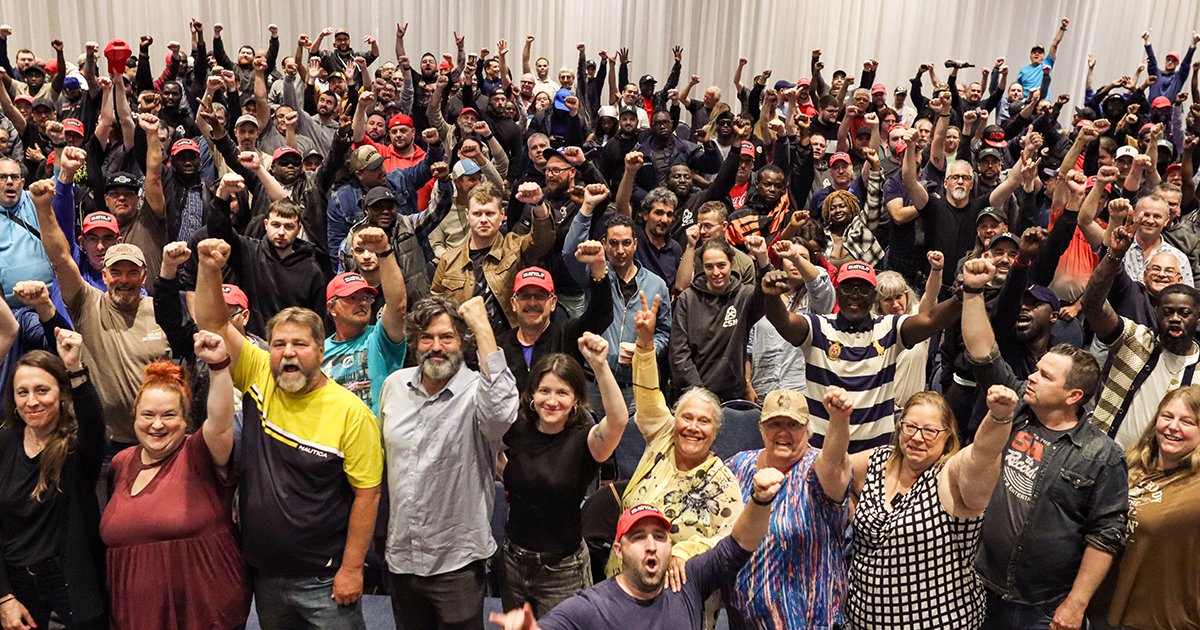
Since March 30, nearly 550 workers at Metro’s Laval distribution centre, its head office, and the drivers’ department at the Mérite 1 warehouse have been on strike. Wage increases are one of the main sticking points in the negotiations. The union contract expired in September 2025 and was negotiated at the beginning of the inflationary period triggered by Covid-19. At present, the starting hourly wage at the warehouse is $20.29, while at head office it is $19.88. The workers, whose purchasing power has declined since 2020, are demanding wage increases that reflect the rise in the cost of living.
The company has refused to budge on their demands. Marc Giroux, whose salary rose 47% in 2025, to $3 million, said last June that the union’s latest offer bore “no resemblance whatsoever to the labour market in general or to the competitive realities of our industry. »4 But Giroux, for his part, apparently deserved his own astronomical raise, thanks to his “new responsibilities as chief operating officer” (of the workers) at a company whose profits have jumped 39% since 2019—and which has returned 40% of those profits to shareholders in the form of dividends. The reality is that the business model championed by Giroux works for investors so long as workers stay stuck in the mud. The dispute looks set to drag on.
The company made an offer in June that the union members rejected by 97%. The following week, the workers’ counteroffer was, in turn, rejected by the employer. The company’s offers reportedly amounted to annual raises of between 1 and 2%. And there is another indignity to add to the list: having denied workers the prospect of a decent standard of living, Metro is now denying them the means to pursue their demands collectively. As early as April, the CSN denounced the use of strikebreakers at the Rivière-des-Prairies facility. Their presence was subsequently confirmed in a report by two labour inspectors who visited the picket-line workplaces. The findings prompted the CSN to file a complaint with Quebec’s Administrative Labour Tribunal (TAT):
“The complaint is based, among other things, on the numerous admissions made during the visit by inspectors from the Ministry of Labour, as well as by managers at the head office and the two warehouses affected by the strike. These managers acknowledged having hired workers through placement agencies to clear out the Laval produce warehouse, and having stepped up the use of workers from independent Metro stores to replace drivers at the Mérite 1 warehouse.”5
Metro has also found ways around Quebec’s anti-scab legislation by outsourcing distribution and transportation work. Courchesne-Larose, for instance, is reportedly operating a distribution centre on Metro’s behalf, having previously owned the facility itself. Canadawide, a Metro partner that imports and supplies fruits and vegetables, is reportedly delivering directly to grocery stores rather than routing its shipments through Metro’s Laval distribution centre.
Since the beginning of the dispute, union members have been served with at least five injunctions barring them from intervening to prevent the company from continuing its distribution and coordination operations by indirect—and illegal—means. Canadawide has accused union members of entering its warehouses without authorisation and vandalising trucks and shipments. IO Solutions has likewise accused workers of vandalism after they entered its call centre at Place Bonaventure last July. The business-process-outsourcing company is reportedly another Metro partner, providing outsourced services that are being used to undermine the strike by head-office employees.
Historical Parallel: Lessons from United Aircraft
For all the comic spectacle of the indignant reactions reported in our newspapers6, there is a parallel worth drawing between the escalating tensions in the current dispute and the very real violence that accompanied the United Aircraft strike of 1974–75. The conflict left its mark on the history of labour law in Quebec. It is said to have helped spur the first Parti Québécois government, under René Lévesque, to adopt Bill 45, which introduced anti-scab provisions and established the Rand formula as a universal principle.7
The United Aircraft dispute unfolded against the same backdrop of high inflation and rising worker militancy as the CTCUM strike (the predecessor of the STM) discussed in an article we published in July 2026. But it was characterised by its length and brutality.
In January 1974, as part of contract negotiations, Local 510 went on strike at United Aircraft of Canada Limited in Longueuil. The negotiations had broken down over wage-indexation rates and the application of the Rand formula. The conflict quickly turned violent. Within the first month, numerous cars belonging to non-union employees were set on fire. It should be noted that not only did several non-union employees continue working, but some, including managers, engineers, and office staff, were also asked to perform production work normally carried out by the striking workers. In February 1974, a foreman’s car was set on fire at his home.
The capitalists at United Aircraft also employed violence against the unionised workers. In addition to the violence placed at their disposal by the state8, the company hired security guards from Garda Security Services, as well as dogs rented at twice the hourly rate paid to the unionised workers at the subsidiary. In February, union leader André Choquette’s car exploded outside his home. On different occasions, the company and the Sûreté du Québec each contacted striking workers, trying, respectively, to persuade them to return to the plant or to act as informants.
In August 1974, homemade bombs exploded on the grounds of United Aircraft of Canada Ltd. The violence reached its peak, however, nearly a year later, in May 1975. Hemmed in by injunctions, reduced in number, and antagonised by the state, the remaining strikers, with the help of construction workers creating a diversion, decided to stage a “hostage-taking” of the machinery at Plant No. 2. The occupation lasted less than a night. It ended with police brutally beating the roughly thirty workers who had entered the plant and then surrendered peacefully to the authorities.
A few weeks later, the union accepted the findings of the Laporte Report, which formed the basis of an agreement with the employer in August 1975. The unionised workers were offered a lump-sum payment of $10 a week to help offset inflation, along with a return-to-work protocol for everyone who wished to return, except for forty workers whose fate was left to arbitration.
The Roots of “Brazen Vandalism”
We are not going to weigh in here on the question of political violence in general. There is no need. The actions of the Metro-Richelieu–CSN United Grocery Workers* are decidedly innocuous compared with those of the production workers at United Aircraft. But the 1974–75 conflict does offer a few useful lessons for our own time when it comes to the question of “vandalism.” At United Aircraft, vandalism was a response to the concerted attacks by the bosses and the state on workers’ power. That power rests on numbers and on the central role workers play in keeping society running. It is the means at workers’ disposal for advancing their collective interests.
In the first week of the strike, United Aircraft workers were served with an injunction ordering them to immediately cease:
“1 — preventing free access to United Aircraft’s plants by any person or vehicle wishing to enter or leave the plants; 2 — threatening and/or intimidating persons doing business with the plants; 3 — occupying private property without permission or damaging it; 4 — obstructing operations at the plants by illegal means; 5 — blocking any of the plant entrances; 6 — encouraging anyone to commit any of the foregoing acts.”9
The following week, another injunction limited picket lines to three participants. A few months later, picketing was banned altogether in the vicinity of the plant. Contempt-of-court charges also rained down on the workers, and Local 501 was ordered to pay the court a $20,000 fine ($126,000 in today’s dollars). These legal measures were handed down as the bosses replaced striking workers on the production line and systematically dismantled union solidarity.10
Just imagine. You vote to strike. Your boss then assigns your work to other workers. The courts and the executive branch prevent you from blocking your replacements from entering the workplace. Your networks of solidarity are dismantled by every means available. The factory keeps running. What is left of your power as a worker? If the situation continues, nothing. Meanwhile, your counterparts in the United States are earning considerably more than you are, and the dogs hired to keep watch over you are being paid twice your hourly wage. The system is narrowing your choices: work under the boss’s shitty conditions, or get the hell out.
It seems that the state itself recognised the danger posed by a situation like the violent conflict produced by such an assault on the power of United Aircraft’s workers. Despite their shortcomings, the provisions of Bill 45 sought to establish a legal framework for the exercise of workers’ power, one that constrained it without destroying it. There was, by then, an obvious legal crisis, laid bare by the proliferation of injunctions issued against striking workers.
The present-day labour movement, too, needs to understand the causes of acts of “vandalism” committed in the course of labour disputes. The recent actions by Metro workers tell us that the power of the unionised workforce is under threat. The company is using legal manoeuvres to have distribution and transportation work carried out by subcontractors. It is taking advantage of the TAT’s sluggishness to hire actual scabs. These means of undermining the power of the Metro-Richelieu–CSN United Grocery Workers’ Union* are available to every one of our bosses. They are the hands of the bourgeoisie around the throat of our class. The members and supporters of Alliance Ouvrière need to recognise this. It is through class solidarity that we must help restore the power of Laval’s workers.
To do so, it has become necessary to broaden the struggle—to bring in forces capable of supporting our class comrades who work at Metro. When an employer, with the help or acquiescence of the state, attacks its employees, there is only one way to resist: through the strength of numbers. Let us multiply concrete acts of solidarity. It is high time to wage an unapologetic class struggle.
- Agence QMI, « Épiceries publiques : un modèle qui finit trop souvent en flop et qui coûte cher aux contribuables, selon un expert, » TVA Nouvelles, May 9, 2026. ↩︎
- Stéphane Grammond, « Le vandalisme syndical décomplexé, » La Presse, July 10, 2026. ↩︎
- See the excerpt on public grocery stores from Rad’s interview with Ruba Ghazal: « Comment Ruba Ghazal et Québec solidaire comptent-ils financer leurs promesses ?, » Le balado de Rad (YouTube), August 20, 2026. ↩︎
- Éric Beaupré, « Conflit chez Metro : refus de la contre-offre, le bras de fer se poursuit entre le syndicat et l’employeur, » Vingt55, June 26, 2026. ↩︎
- Confédération des syndicats nationaux (CSN), « La CSN dépose une plainte au Tribunal, » May 7, 2026. ↩︎
- With some embellishment, this La Presse article describes union members’ nonviolent entry into IO Solutions’ offices as a rampage: Richard Dufour, “Place Bonaventure : des syndiqués de Metro saccagent un bureau,” La Presse, July 23, 2026. ↩︎
- This is a form of « union security under which the employer agrees to deduct from each employee’s pay, whether or not they are a member of the union, an amount equal to the union dues and remit it to the union, » Office québécois de la langue française, « Formule Rand, » Grand dictionnaire terminologique. ↩︎
- The company reportedly reached an agreement with the police service under which all necessary overtime for police officers would be paid. After two months of conflict, the agreement had already cost more than $145,000 — nearly $1 million in today’s dollars. ↩︎
- Michel Pratt, La grève de la United Aircraft, Presses de l’Université du Québec, 1980, 77. ↩︎
- Ibid. ↩︎