Introduction
$151 million in budget cuts, aging infrastructure, cancelled programs, mounting student precarity: austerity is taking its toll all across the cégep network. At Cégep de Saint-Laurent, buildings are crumbling, a French-language program has been shut down, and staff are stretched thin and increasingly precarious. It was against this backdrop that students mobilised in the winter of 2026.
Rebuilding a Culture of Mobilisation
For several years now, Quebec’s student movement has been in something of a lull, especially compared with the mobilisations of 2012 and 2015. Cégep de Saint-Laurent is no exception, despite the significant role it played in those previous movements. In the years leading up to the winter 2026 mobilisation, the school’s student association (AECSL) wasn’t inactive exactly — just fairly quiet.
When students voted to strike at general assembly, it was, in truth, mostly symbolic: the AECSL would sign an agreement with the administration — symbolic in its own right — stipulating that at least one hundred people had to be gathered outside the college before 8 a.m. for classes to be cancelled. That threshold was often difficult to reach. Many will remember the panic that would set in at 7:45 a.m. when we were still short a few students, followed by the desperate phone calls to friends in the residences, who were still asleep. Even when classes were cancelled, employees, including instructors, could still report to work. In return, students had access to the Grande Salle, where the AECSL organised screenings of activist films and discussion circles attended by only a handful of students.
In the winter 2026 semester, as the Coalition pour la résistance et l’unité étudiante syndicale (CRUES) launched a campaign against austerity, the AECSL decided to break with this tradition and change its strategy. The goal was to put an end to symbolic strikes and revive a strong, openly political culture of student mobilisation, in the hope of building greater leverage with the administration during negotiations. At Saint-Laurent, the effects of austerity are visible and tangible, which makes the issue especially fertile ground for organising.
But the budget cuts are not affecting students alone. They’re also hitting cégep staff hard, who are dealing with an increased workload driven largely by resource shortages and hiring freezes. And to make matters worse, many of them hold precarious positions and can never be sure they’ll have a job the following. Out of this shared reality, a collaboration takes shape between the cégep’s organising committee (CO) and the AECSL, which broadens its demands to include those of staff as well.
Ahead of the strike general assembly, the student association launches a major information campaign on austerity, using posters and short-form videos posted to Instagram, among other tools. The aim is first to explain the issue in accessible terms and show how austerity is affecting the school, and then to make clear that austerity is a political choice. By placing budget cuts side by side with the sums our governments invest for the benefit of the economy’s biggest players, the campaign sets out to demonstrate that austerity is not an inevitability: it is the result of political choices that place capital above the wellbeing of society.
Students vote overwhelmingly in favour of a week-long strike, longer than the student association had initially proposed. As the assembly unfolds, the general enthusiasm becomes contagious: we find ourselves united in a common struggle, caught up in the exhilaration of change.
Without having deliberately set out to do so, the strike takes on a highly participatory form. In the run-up, open strike councils are organised for anyone who wants to take part. On the picket line, the AECSL members negotiating with the administration report openly on the state of the talks while canvassing students on how to proceed. Recap videos, published almost daily, likewise let students follow the fight as it plays out and take part in it directly.
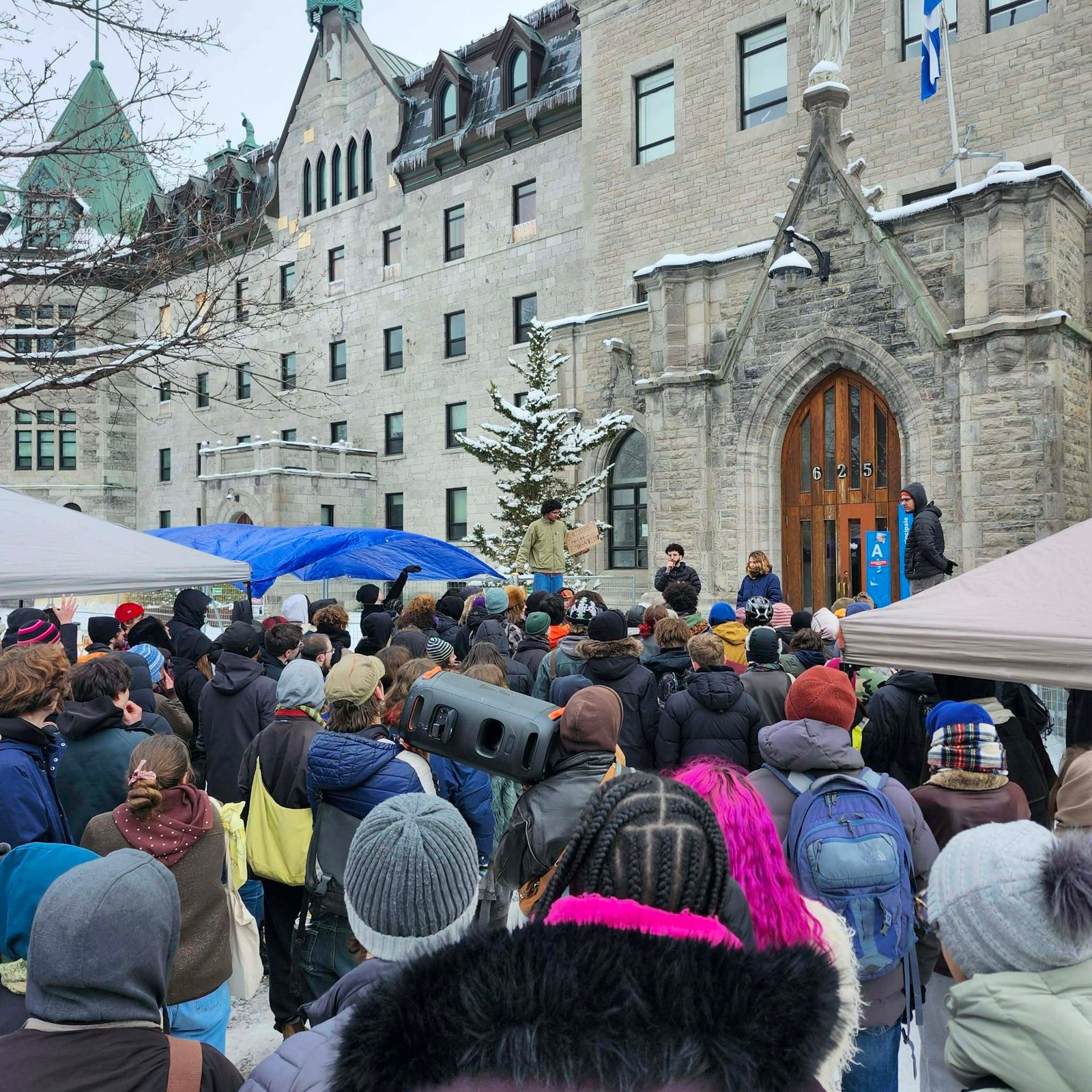
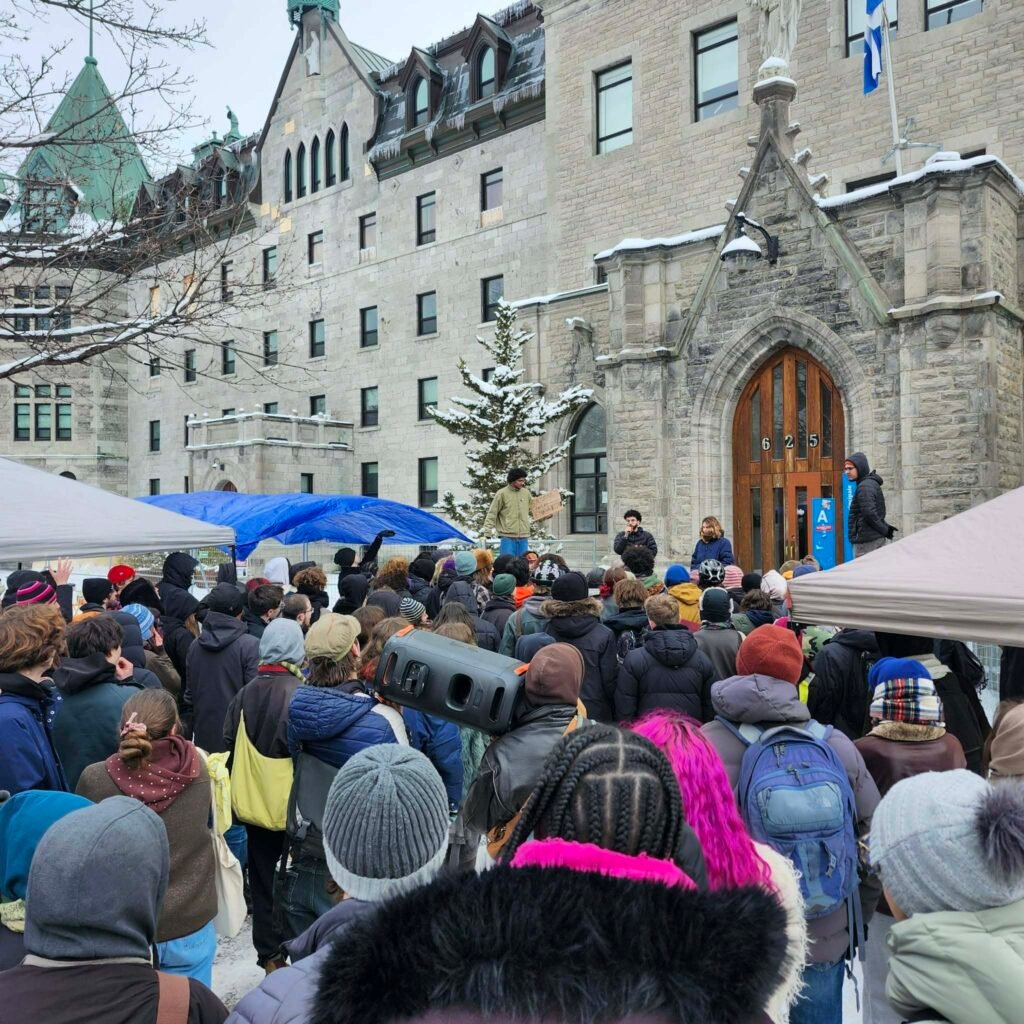
The result is a historic mobilisation at Cégep de Saint-Laurent, marked by a hard blockade and a picket line drawing together several hundred people. Some students spontaneously take it upon themselves to cook; others paint banners or play music. A sense of community takes root and grows stronger over the course of the week. In the aftermath, several students are elected to the AECSL executive, and the May 1 strike, despite a less sustained campaign, proceeds without difficulty.
The Work Ahead
Student mobilisation is often hard to sustain at the cégep level, in part because the student population turns over so quickly. For struggles to endure, they need to be renewed every semester and remain accessible, easy to understand, and, above all, participatory. While we managed to spark strong mobilisation last winter, there are still many students we have yet to reach. For the AECSL to become an indispensable hub within the school, it must diversify its activities so that everyone can find a place in it.
The Cégep de Saint-Laurent student association advances anti-capitalist, antifascist, environmentalist, feminist and antiracist demands. For those demands to be more than symbolic, the AECSL must aspire to become an agent of social transformation. We believe that while the strike is both an important pressure tactic and a space for mobilisation, it cannot be the only form of political activity its members engage in.
Between strikes, then, we need to encourage more direct involvement in ongoing struggles. That involvement can take the form of more combative tactics, like blockades, occupations, and targeted direct actions, or of engagement in solidarity and self-organising initiatives within the community. To make this happen, we believe it’s essential to build ties with organisations already working on the ground — Offensive Populaire (OP), Greniers Agricoles, Alliance Ouvrière (AO), KM 134 — so that it becomes easy, even natural, for students to get involved in concrete ways.
At the cégep, the fall 2026 semester has opened with the announcement that yet another building will be closed. We will need to keep fighting the effects of austerity at Cégep de Saint-Laurent, all while showing that these are not mere accidents along the way, but the product of a system built to serve the ruling class. At the same time, by building ties with other organisations, we hope to draw students into openly transformative social struggles. In doing so, we hope to show that it’s possible not only to refuse a system that abandons us, but to lay the groundwork for a world beyond it.
Members of the AECSL,
August 2026