Special contribution by Alexis Lafleur-Paiement of the Archives Révolutionnaires collective
Introduction
In the fall of 1973, the first oil crisis shook the global economy and marked the end of the “Glorious Thirty.” This was followed by stagnant economic growth and rising prices, a phenomenon known as “stagflation.” Against this backdrop, Pierre Elliott Trudeau’s government chose to place the burden of the crisis on workers. Through Bill C-73, the Canadian government capped permitted wage increases in several sectors, including the public service, large corporations, and construction. While employers were satisfied with the proposed measures, unions and left-wing organizations strongly denounced the new policy. In response, they organized the largest political strike in Canadian history.
An Unprecedented Attack on Workers
At the turn of the 1960s and 1970s, governments and employers faced an increasingly assertive labour movement. On one hand, the Canadian Labour Congress (CLC) led the fight to unionize all public servants and to guarantee their right to strike. On the other hand, Quebec unions were moving closer to socialist ideology and formed their first united front in the spring of 1972, which led to significant gains. The unions sought to secure favourable conditions for public-sector employees, hoping this would force improvements for all workers, including those in the private sector.
As a result, the government and business owners faced the same adversary: the organized labour movement. The early-1970s crisis provided an opportunity to impose a wage control policy designed to limit the scope for union action.
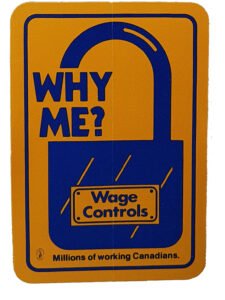
In the fall of 1975, the Trudeau government passed the Anti-Inflation Act (C-73), which imposed strict controls on wage increases in several key sectors. For civil servants, large-corporation employees, and construction workers, increases were capped at 10% for 1976, 8% for 1977, and 6% for 1978. These rates were below the inflation rate and signalled a loss of purchasing power for workers.
Such state intervention in the economy was unprecedented since World War II, especially since it interfered with the negotiation of private-sector employment contracts, contrary to the principles of economic liberalism. In fact, this policy heralded the neoliberalism that would take hold over the following decade—a movement characterized precisely by government intervention to counter the unions. However, it failed to account for the labour movement’s resolve, which stepped up protests against Bill C-73.
A Massive and Bold Response
From the beginning of 1976, several groups of workers opposed the new legislation, particularly in low-wage sectors such as food processing and textiles. The idea of a broad-based struggle against Bill C-73 quickly emerged among local unions and activist groups. Because the law affected broad sectors of the working class, organizers planned a general strike to challenge it. However, union leadership was reluctant, as such action would be illegal. In Canada, strikes are permitted only during the renegotiation of collective bargaining agreements.
Despite everything, the growing anger and determination of the workers convinced the major labour federations to call for a general strike. The goal was to bring the country to a standstill to force the government to withdraw its wage control policy.
The CTC led the movement and called a national strike on October 14, 1976. The call was widely heeded, and more than 1.3 million workers walked off the job for the day. This action was unprecedented for several reasons.
First, it mobilized workers from coast to coast, in major cities and remote regions, in both the public and private sectors. Second, it involved the largest number of workers on strike simultaneously in Canadian history. Finally, it took place outside the legal framework, with a clear political objective: to force the Trudeau government to withdraw its “anti-inflation” legislation.
In Quebec, one-third of unionized employees participated in the strike, which was more than 230,000 people. Although the strike lasted only one day and did not repeal Bill C-73, it had a decisive impact. The Trudeau government did not renew its wage control measures after 1978, and no other government dared to reinstate such provisions thereafter.
Conclusion
Fifty years later, what lessons can be drawn from this strike—as surprising as it is little-known?
First, the government is not neutral in managing labour relations, and its actions are all the more restrictive because it is both the country’s largest employer and the sole legislator. However, concerted worker action can also reestablish a balance of power and assert the rights of the majority, even outside election cycles and collective bargaining periods. As Mark Carney’s government rolls out more anti-environmental, militaristic, and anti-union policies, it may be time for the labour movement to return to political strikes, a legitimate strategy that has proven effective in the past.