Behind every stocked shelf and on-time delivery is a warehouse worker moving faster, earning less, and stretched to the limit. It doesn’t have to stay that way.
Imagine you work somewhere in a warehouse in Saint-Laurent.
You wake up for your shift; maybe it’s early morning, maybe you’re working the graveyard shift. Your phone buzzes before you even get out of bed. Your boss is asking if you can come in a couple of hours earlier again. You hesitate for a second, but you say yes anyway. Your rent is high, and so is your grocery bill, and a few extra hours make a difference. You take the bus. (It’s late.) You rush to clock in.
The shift starts. You do what you always do—moving, lifting, scanning. The work is constant, and it doesn’t slow down. When you finally get a break, you eat quickly. You’re already tired, and the day has barely started.
Then your supervisor calls you in. He tells you that your numbers aren’t high enough. You’re told to talk less. Work faster. Be more efficient. And that your vacation request has been denied.
You leave frustrated. You try to push back, maybe through a union rep, but you’re told there are no grounds for a grievance under the collective agreement, and without a violation, the union has no basis to intervene.
Later, you go home. You stop by the grocery store and notice that prices have gone up again. Bread costs more than it should, and somehow, gas is higher than it was last week. You think about the extra hours you picked up and realize they have been already accounted for.
Nothing about this feels accidental. And if you don’t work in places like Saint-Laurent, you might never notice it. What you see instead are stocked grocery shelves and delivered packages. This invisibility is functional: it sustains the system by keeping its underlying relations unexamined. But imagine, for a moment, that this is your day, your routine, your paycheck. It would be strange not to feel angry in conditions like these.
The problem is not just one workplace, or one bad boss, or one difficult shift. It points to something broader, which becomes clearer when we look at how labour in Saint-Laurent is organized.
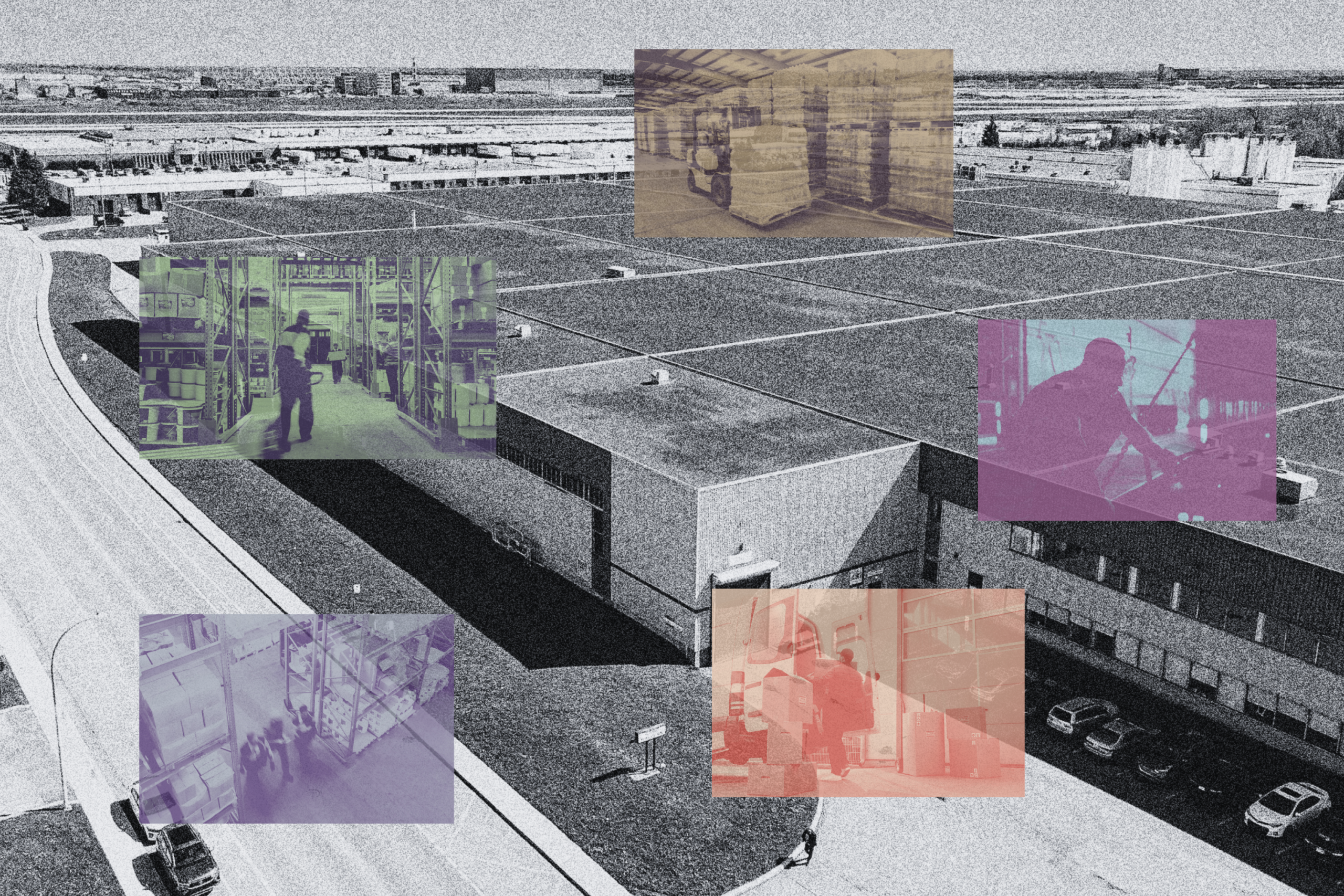
Saint-Laurent is one of Montreal’s main industrial areas. Highways 13, 40, 520, and 15 criss-cross, providing easy access for trucks. Nearby, a major airport and rail terminals connect it to wider networks of circulation. Massive factories produce goods, massive warehouses store them, and everything is organized to move as quickly and cheaply as possible. The concentration of infrastructures and industries facilitates the quick and inexpensive movement of goods. This structure reflects how profit maximization shapes space itself—through wide roads, massive buildings, and infrastructure designed for constant movement.
And goods, as you may already suspect, do not move on their own. Their movement depends on labour: the workers who load, transport, and process them at each stage. The value created through this labour is not retained by those who perform it, but is captured as profit by those who control the infrastructure through which goods circulate. In this sense, Saint-Laurent functions as a concentrated site of a more general relation: workers produce value, and capital extracts it.
What sharpens this relation is the density of the system itself. Workplaces are densely clustered and linked through the continuous flow of commodities, which is, in practice, an interconnected network. What is obscured is the dependency that develops when production and distribution are so tightly coordinated. Any event of disruption becomes difficult to manage. A slowdown in one site can generate pressure across others, exposing how reliant the system is on the continuous activity of labour.
And none of this is new. Saint-Laurent has long been shaped by industrial concentration and migrant labour. Historically, these same conditions of density, proximity, and shared experience, allowed organizing to extend beyond individual workplaces and into everyday life. For decades, workers have poured into this concrete quartier, building both the system and the relationships within it. This dynamic has not disappeared. It has changed form through logistics, warehousing, and service work, but the underlying conditions remain. Workers are still concentrated, still connected, and more than ever failed by the very system that they keep running. Where formal labour representation exists, it often remains confined to what can be addressed within individual workplaces and even more so by contractual limitations. No one should be surprised to find the workers frustrated, angry, exhausted, and prepared to turn the quartier into an arena of concrete, collective action.
For workers, this is felt every day, as they face the same pressures: faster pace, tighter schedules, unstable hours, rising costs of living. They run into each other on the same bus routes, in the same neighbourhoods, in the same break rooms. They complain to each other about their lives, get mad on each other’s behalf, and create relationships that help them find solutions to their issues together. Though what may seem like ordinary, incidental interactions, workers are already making sense of their conditions as something shared.
Workers are not starting from zero. They already carry the knowledge of their conditions, and their frustrations are developing small forms of resistance, even if they have not yet taken organized form. The question is not whether something exists, but whether it is recognized and developed.
To most people, this work remains invisible. You see stocked shelves, packages arriving on time, food available when you need it. The system appears stable, almost automatic. But is it really? Imagine, even briefly, what happens when that movement slows. Perhaps not everywhere at once, but just enough to disrupt the flow. Your deliveries are delayed, and grocery store shelves are beginning to empty. What appears distant suddenly becomes immediate. Because the comfort many take for granted rests on work they do not see. Offices, services, and the rhythms of daily life all quietly depend on the continuous activity of workers in places like Saint-Laurent.
Without that labour, the system stops. No position, no salary, no distance from the shop floor removes that dependence. However high one rises, the basic conditions stay the same: food must be produced and moved, goods must circulate, and labour must make it happen. What is often treated as secondary work is, in practice, foundational, and once made visible, it becomes quite difficult to ignore.
If we are serious about building working-class power, then we cannot afford to remain distant from places like Saint-Laurent. We cannot treat them as secondary, or wait for struggles to appear fully formed. We have to be there not as observers, not as outsiders showing solidarity, but fully as participants learning from workers, building relationships, and helping turn what already exists into something organized and sustained.
We need to remember that relying solely on formal organizing channels means accepting the limits already built into them. Those limits reinforce the isolation that keeps workers manageable. The system that runs Saint-Laurent depends on workers remaining isolated and replaceable. Building a coordinated network of workers, activists, and neighbours directly challenges how the supply chain is designed to operate (and whether it continues to perform its function).
If the reality for many workers is already this extreme, as it is becoming increasingly defined by pressure, precarity, and constant sacrifice, then our response cannot remain cautious, distant, or symbolic. It has to rise to meet that reality, and with the conditions already there, the only question left is whether we are willing to meet workers where they are and help them build a movement that is impossible for their bosses to ignore.